Tuesday, August 10, 2021

A Special Gift

Today, on my 71st birthday, my wife gave me a book by a 94 year-old author.  The writer is David Attenborough, perhaps the best known naturalist on the planet and renowned for his many nature documentaries, including Life on Earth, The Blue Planet and Planet Earth, among others.

His new book, A Life on Our Planet, chronicles the loss of biodiversity on Earth and how that steady, ongoing process threatens every form of life on the planet, humans included.  Fortunately, Attenborough also discusses how we can reverse course by re-wilding natural ecosystems.

As one who has long been interested in natural history and who is increasingly distressed by human-induced climate change, the destruction of natural habitat and the poisoning of marine and terrestrial ecosystems, this is a special gift.  I recommend the book for anyone who shares Attenborough's devotion to the health of our planet. 

Sunday, August 8, 2021

The Southern Waterthrush

Unlike the northern waterthrush, which breeds across southern Canada, New England and the Great Lakes region, the Louisiana waterthrush summers throughout most of the eastern U.S., including the Deep South (Florida excluded).  Favoring wooded streams and bogs, these birds wander atop logs and boulders or along muddy banks, bobbing their tail as they search for insects and aquatic invertebrates.

This morning, a friend and I were fortunate to encounter a Louisiana waterthrush at Eagle Bluffs Conservation Area; as is often the case, it was in a shaded ravine where water drained from one of the refuge pools.  Prothonotary warblers, also drawn to riparian woodlands, joined the waterthrush but fed primarily in the trees and shrubs.

Both northern and Louisiana waterthrushes winter in Central America or on Caribbean islands.  During the spring and fall migrations, both species may thus be encountered in the Southeastern U.S. but only the aptly named Louisiana waterthrush stops to nest in the hot, humid confines of the Southeast and southern Midwest. 

Saturday, August 7, 2021

Flashback Post XXII

It is hot and humid here in the Midwest and football practice has begun, a deadly combination for a few young players each year.  See my post below from June of 2013.

The Season of Needless Death 

Addendum:  Just turned on the TV to find that they are running the men's Olympic Marathon in 85% humidity; I rest my case.

Thursday, August 5, 2021

The Sapling Songster

Fairly common summer residents across the southern half of the U.S., blue grosbeaks favor weedy fields with scattered trees.  In my experience, the male often sings from the top of a small tree; though he has a distinctive tune and is significantly larger, he may be mistaken for an indigo bunting.

Blue grosbeaks usually feed on the ground, consuming a wide variety of insects, spiders and seeds.  Most often seen alone or in pairs, they gather in loose flocks by late summer as they prepare for their migration to Mexico and Central America.

I have been fortunate to encounter several blue grosbeaks in central Missouri this summer, including a lone male at Perry Phillips Lake this morning.  While they are not rare, it is always a pleasure to encounter these songsters which are greatly outnumbered by their usual neighbors (indigo buntings, goldfinches and dickcissels).  

Wednesday, August 4, 2021

Concerned at Forum Nature Area

Forum Nature Area stretches along the floodplain of Hinkson Creek in Columbia, Missouri.  A patchwork of woodlands, wetlands, prairie and a seasonal lake, the refuge is accessed by a double trail loop and has always been an excellent area for birdwatching.

So, on this sunny, mild morning in Columbia, I took a leisurely walk along the 1.5 mile circuit, attentive to the sight and sounds of bird life; unfortunately, my visit was a bit disappointing.  During my one hour visit, I saw only 11 species and at least a third of my sightings were of northern cardinals.

Veteran birders know that, on any given day and despite the weather conditions, a bird count may vary widely.  Perhaps it is due to my aging eyes and ears, but the low count days seem to be increasing.  My concern, of course, is that the effects of our poor stewardship of planet Earth are becoming ever more apparent, even at a modest sized nature preserve in a small, progressive-minded Midwestern city.

Tuesday, August 3, 2021

A Natural Invasion

Across the arid and semiarid regions of the Western U.S., drought tolerant grasses, sage, wildflowers, cacti and low shrubs adorn the open landscapes; trees, if present at all, cluster along streams and drainages.  Abandoned barns, lashed by wind and storms, slowly crumble over the decades, untouched by vegetation.

Here in the Midwest and across the Eastern U.S., where precipitation is plentiful, such structures are rapidly enveloped by an assortment of vines, shrubs and trees, accelerating the barn's decomposition.  Indeed, farmers and suburban home owners are in a state of war with natural vegetation throughout most of the year, mowing grass, weeding flower beds, removing invasive vines, trimming shrubs and cleaning up the "debris" from trees.  Some utilize herbicides while the rest of us endure endless rounds of yard work to keep up with seed dispersal and rapid plant growth.

At our Columbia property, tree seedlings are especially problematic, taking hold wherever the grass is not dense enough to discourage their invasion; red bud, mimosa and black maple seedlings are most abundant, matched only by oaks after heavy mast seasons.  While I would not mind living in a forest, others might object, especially during its gradual and "messy" development.  So the yard work continues, offering exercise and conferring a healthy respect for nature's dominance; she will, of course, win in the end.

Sunday, August 1, 2021

Avocets at Eagle Bluffs

On this sunny, mild morning in central Missouri, a friend and I encountered a flock of eight American avocets at Eagle Bluffs Conservation Area, a special treat for those of us who reside in the lower Missouri River Valley.

Having nested along shallow ponds of the Western High Plains and saline pools of the Great Basin, avocets begin to drift southward by late summer, heading for coastal bays and mudflats of the southern U.S. and Mexico.  In both seasonal locations, they feast on a wide variety of aquatic invertebrates which they locate with their long, up-curved bill.

August and September, though part of the "astronomical summer," are the peak months of the autumn shorebird migration.  While many of these travelers challenge novice birders with their small size, restless behavior and seemingly generic plumage. American avocets are easy to identify, even at a distance.  If for no other reason, they are always notable visitors at this floodplain refuge.

Saturday, July 31, 2021

Park Improvement

Back on April 23, I wrote about the "development" around Perry Phillips Lake in southeast Columbia.  While I assumed that more housing would be built in a field west of the lake, I learned today that the work will result in "park improvement," including a covered pavilion for park visitors and local residents.  Needless to say, that news did not ease my disappointment.

Development is development.  Natural habitat loss occurs whether new apartments or suburban park structures occupy the site.  I doubt the pavilion will be the only "improvement;" chances are, it will be flanked by a playground, grills and "comfort facilities" among other human requirements.  Parks, after all, are for humans; the wildlife will adapt.

The relentless destruction of natural habitat has long had a negative effect on native wildlife.  Indeed, American bird populations have decreased dramatically over the past fifty years.  No worries though; we can always go to zoos to see them, just as we did with the passenger pigeon.


Thursday, July 29, 2021

From Oven to Steam Bath

Driving eastward across the High Plains yesterday, my Beetle and I were enveloped in hot, dry air as a steady, southwest wind brought oven-like conditions up from the Desert Southwest.  With each stop across Kansas and western Missouri, the temperature fell as the humidity rose; stepping from the car in Columbia, I entered a steam bath. 

In the course of my journey, I had left the rain shadow of the Rockies and entered the broad moisture plume from the Gulf of Mexico; of course, the elevation of the terrain had also gradually fallen and the "thin air" of the High Plains had become the thick, humid air of the American Midwest.  Reflecting that change, the dry, nearly treeless landscape of eastern Colorado and western Kansas transitioned to the verdant fields and woods of the Heartland.

Unlike the High Country, where radiative cooling drops overnight temperatures into the upper 50s or lower 60s (F), darkness brings little relief in the Midwest; beyond the air-conditioned confines of our house, the steam bath lurked this morning.  Fortunately, a cold front is expected to arrive by this weekend, bringing rain and cooler air.

Tuesday, July 27, 2021

The Hostile Universe

Since the Big Bang, some 13.7 billion years ago, countless suns have exploded or dimmed, destroying their planets or leaving them in the frigid darkness of space.  Of course, any form of life on those planets could not survive such a catastrophe.

Planets are also prone to destruction from collision with comets, asteroids or other planetoids and their life forms (if they exist at all) are threatened by a gyrating climate, courtesy of such collisions, volcanism or other natural forces (not to mention man-induced global warming).  Indeed, life on Earth, as on other planets, is fragile and transient.

As we gaze upon Earth's beautiful landscapes, they appear to be permanent until, as we have seen in recent weeks, extreme events (wildfires, floods, earthquakes) destroy that illusion.  Perhaps it is best to regularly turn our attention to the night sky to remind us how insignificant we and our home planet really are. 

Sunday, July 25, 2021

Subjective Sporting Events

Now that the Olympics are underway once again, I find that I am drawn toward sports which are characterized by man/woman/team against time, distance and physical forces.  Swimming, track, golf, speed skating and downhill skiing offer good examples; while "false starts" sometimes come into play, they are now detected with the use of technology.

Less appealing (for me) are sporting events that rely on the subjective opinion of judges; diving, gymnastics, freestyle skiing and figure skating offer obvious examples.  While one cannot deny the athletic skills, conditioning and devotion of the participants (as well as the professional qualifications of the judges) it is difficult to ignore the possibility (if not probability) that favoritism and nationalism influence the scores.

Perhaps I am demonstrating my personal cynicism by admitting to this preference but, as a student of human nature, I am more inclined to trust the judgement of technology than the eyes and hearts of my fellow humans.  We are better equipped to appreciate art, music and natural beauty than we are to detect subtle differences in athletic performance. 

Thursday, July 22, 2021

Thoughts on Homelessness

Homelessness is a tragic scourge in this wealthy country.  It is also a dangerous condition, both for those who live on the streets and for the public at large.

Guided by empathy as well as security and public health concerns, we cannot allow homelessness to persist; while the solution is complex and expensive, it can be achieved.  First of all, we must build adequate housing for those currently on the streets.  During placement, individuals should be assessed to determine if they have significant medical or psychiatric conditions, if they have a criminal record and if they have special needs (such as childcare). This assessment will thus determine where they will be placed and counselors at those centers or housing units will direct them to proper care, detox programs, job training, etc.

Finally, it cannot be a personal right to live on the streets.  As long as we provide adequate food, shelter, health care and education, we should not tolerate a choice that potentially endangers all members of our society.  Law enforcement, social service and the health care system must all play a role and we must generate adequate funding (through taxation and philanthropy) to eliminate homelessness in our communities.

Tuesday, July 20, 2021

From Drought to Flood

The annual Southwestern Monsoon has developed over the past week or so, bringing much needed rain to the parched landscape of the Sonoran and Chihuahuan Deserts, the Colorado Plateau and the Great Basin. While brief, heavy rain is typical of this weather pattern, regional flooding is especially severe this year.

Of course, climate change is fueling both the extreme drought and the destructive floods; the severe heat in the Pacific Northwest, torrential rains in the Southeast and catastrophic flooding in Germany also reflect the natural consequences of a warming climate.  As wildfires rage across the Western U.S., the monsoon moisture will be welcomed but heavy rain over short periods of time may unleash mudslides and flash floods, especially within and near the burn scars.

Some effects of the monsoon are expected to reach the Colorado Front Range over the next few days, well ahead of schedule; August is generally the period of monsoon rains in this region, often extending into early September.  Since we have enjoyed a wet spring and summer (to this point), we may also experience flooding in the foothill canyons and along tributaries of the South Platte River.

Sunday, July 18, 2021

Back to Painting

One of my hobbies is landscape painting but I often neglect it for periods of time.  Indeed, I tend to resume painting in mid summer and mid winter when the weather is less inviting for outdoor activities.

Rather than paint at the location or from a photograph, my landscapes are purely imaginary or, more often,  inspired by scenery that I have encountered in the past.  I prefer acrylic paints (which clean up with soap and water) and generally complete each painting in a matter of hours or days.  Somewhat impressionistic, they tend to be colorful, perhaps reflecting my personal view of the natural world.  Over the past few days I have completed three of them, which now adorn the walls of our Littleton farm house; to consider selling them would be pure folly.

In my experience, most individuals who paint find that it is relaxing and therapeutic and usually combine the activity with listening to music; as a naturalist, I also find that painting landscapes is a form of paying homage to nature and her varied ecosystems.  Finally, the finished product reminds me of pleasant excursions in the past and encourages me to explore other locations.  If you have never tried painting, I highly recommend that you take the plunge, regardless of your self-perceived artistic talent.

Wednesday, July 14, 2021

A Mulberry Feast

We have several mulberry trees (including a weeping mulberry) on our Littleton farm and, though the crop is a bit late, it is plentiful.  As usual, the trees and their patrons are making quite a mess on the driveway and walkways.

American robins and house finches are the most abundant consumers, joined by magpies, crows, starlings, blue jays, cedar waxwings, lesser goldfinches and even broad-tailed hummingbirds.  Bullock's orioles are irregular visitors (one stopped by this afternoon) and western tanagers may partake of the fruit though most remain in the upper foothill forests during the summer months.  Mammalian patrons include fox squirrels, raccoons, skunks and red fox; no doubt, mice and voles also scour the ground for fallen fruit at night.

As I have mentioned in the past, mulberry trees are good trees to plant in semiarid environments.  While they attract an excellent diversity of wildlife they are also drought tolerant; I have never watered those on our property and they manage just fine with what moisture nature provides.


Tuesday, July 13, 2021

An Owl at Mid-Day

On this mild, cloudy day along the Colorado Front Range, I went out to explore our Littleton farm, looking for but hoping not to find problems that developed during my three-week absence.  Fortunately, none were encountered but I was accompanied by a pleasing mix of birds, including cedar waxwings, a Say's Phoebe and a great horned owl.

The latter, trailed by an excited posse of chickadees, glided just overhead and landed in one of our piñon pines.  Once his pursuers abandoned their harassment, the raptor moved to a nearby linden where his presence would be less noticeable within the heavy foliage.  Sure enough, he remains there an hour later, unmolested by our local jays, crows and magpies.

Though we most often associate owls with cold, clear nights, they are occasionally active during the day, especially when low clouds (or the smoke from distant wildfires) block out the sun.  Though our resident fox has decimated the cottontail population, there are plenty of mice and voles to keep this hunter around (not to mention the occasional skunk).

Monday, July 12, 2021

The Front Range Greenery Persists

After a three week absence, I returned to our Littleton, Colorado, farm to find that the unusual summer greenery persists; in fact, the trees, shrubs and "grass" may be more lush than they were when I left.

In most years, the farm begins to "brown-out" by early July and remains dry until the monsoon rains of August-September provide some relief.  This year, regular showers and thunderstorms have bestowed a Midwestern look on the property (without the humid air that characterizes that region).  While much of the West remains excessively hot and dry, the Front Range has, so far, been spared.

As a reminder that we are not far from the fire lines, a smoky haze obscured the mountains as I drove into Metro Denver this morning.  Despite our luck this season, we cannot forget that this is a semi-arid ecosystem; hopefully, most residents and businesses will dispense with unnecessary irrigation while our good fortune lasts.

Saturday, July 10, 2021

The Nature of Truth

Truth is absolute.  It is not defined by belief, opinion, experience or hope.  The search for truth is the essence of science and, many would agree, the driving force in our lives.

Unfortunately, truth is often denied, hidden, altered or ignored, usually to achieve personal benefit or opportunity; indeed, individuals may refuse to accept truth that elicits unwelcome doubt or complicates their life.  Too often, humans create their own reality and live within the safe confines of that belief system.

Whether we spend our lives seeking and responding to truth or avoiding it, truth prevails.  It governs our lives, our relationships, our environment and our Universe.  We ignore truth at our own peril. 

Friday, July 9, 2021

A Newborn Skink

American five-lined skinks are common on our Columbia, Missouri, property and I have surely seen hundreds of them over the past two decades.  But, for the first time, I observed a tiny hatchling while sitting on the porch last evening.

No larger than an earthworm, the newborn skink, sporting the bright blue tail of a juvenile, foraged within the crevices of our brick walkway.  Its mother was impregnated back in May, laid her eggs (up to 18) in June and cared for them until they hatched (after an incubation of 4-6 weeks).  The youngster that I encountered was surely no more than a few days old but may live for up to six years.

Five-lined skinks feast on a wide variety of spiders and insects in addition to fruit and vegetable matter.  They, themselves, are potential prey for crows, jays, herons and a host of small mammals.  My best wishes for our newborn neighbor. 

Thursday, July 8, 2021

Cliff Swallow Spectacle

This morning, at Phillips Lake Park in Columbia, Missouri, my wife and I observed a large flock of cliff swallows building or repairing nests on the covered boat dock.  The energetic birds repeatedly flew between a construction site and the dock, using mouthfuls of mud to construct their gourd-shaped nests; at least 100 were involved in the project.

Since they winter in southern South America, cliff swallows generally arrive in mid spring and produce nestlings by early summer, thereby insuring that they are ready for their "fall migration" by late August or early September.  This morning's spectacle was thus unusually late, possibly resulting from a delayed spring arrival (due to our chilly, wet spring weather) or to a failed nesting attempt earlier in the season.  Foul weather, disease or human interference may have played a role; since their large (sometimes massive) colonial nest sites can be a nuisance near human habitation (due to excrement, mites, noise, etc.) they are sometimes destroyed.

Regardless of the cause, this mid summer nesting frenzy what a sight to behold.  No doubt, they will leave a mess behind when they finally head south but their vital role in natural insect control cannot be denied.

Wednesday, July 7, 2021

Storm Damage at Eagle Bluffs

For the first time since last week's storms, I returned to Eagle Bluffs Conservation Area this morning.  There I found significant tree damage from the high winds and extensive flooding across the Missouri River floodplain which damaged most of the crop fields.  Fortunately, the graveled roadways remained intact.

While the strong storms and torrential rain disrupted human activity, wild residents of the refuge were unfazed and, in some ways, benefitted from the severe weather.  Great blue herons and great egrets were especially active and abundant, foraging in the shallows, roosting in trees or cruising above the soggy landscape.  On the other hand, waterfowl were limited, represented only by a small number of Canada geese, mallards and wood ducks, and raptors were absent altogether.  Sightings of note included a large number of killdeer and indigo buntings, a few lark sparrows and a lone blue grosbeak.

Experiences such as mine this morning remind us that we are at the mercy of natural forces.  Nature sculpts the landscapes and sustains the ecosystems on which we depend; offering fertile floodplain soil for our crops, she might also destroy our efforts with impunity.

Monday, July 5, 2021

Warrior in the Grass

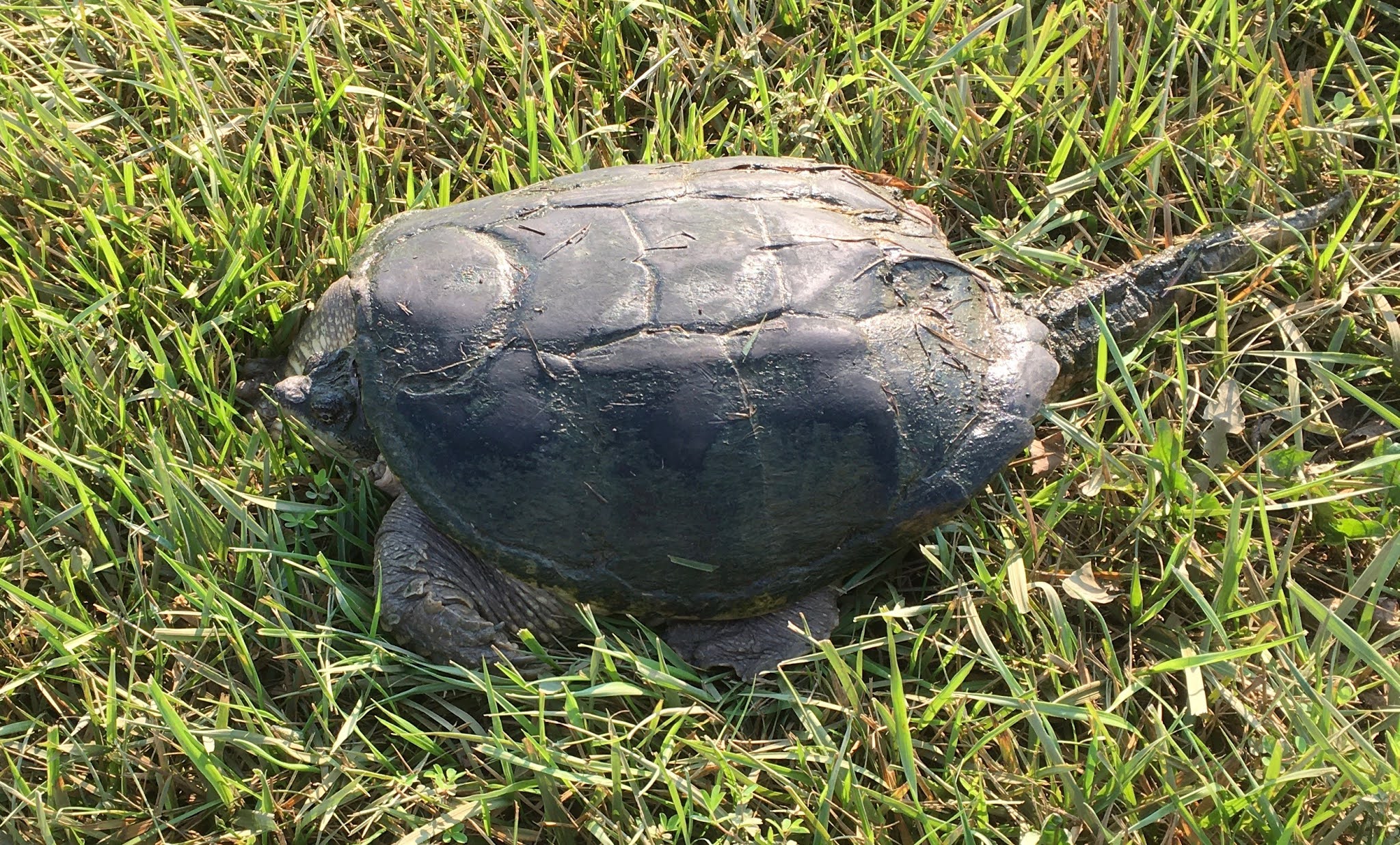
Walking around Phillips Lake this morning, in southeast Columbia, my wife and I encountered a snapping turtle, lounging in the grass.  Since these long-lived, prehistoric creatures seldom leave their aquatic home, I surmised it was likely a female, surveying a location to lay her eggs.

Found throughout the eastern 2/3 of North America, common snapping turtles have a low level of successful reproduction but may live for a century.  Favoring shallow lakes and bays, they feed on a wide variety of creatures, including invertebrates, fish, frogs and aquatic turtles, unwary herons and small mammals as well as on carrion.  Natural predators are limited to larger snappers, alligators, river otters (when the snappers are relatively young) and coyotes or bears (when traveling to nest sites or between lakes).

Indeed, the snapper that we observed this morning was missing a section of its posterior carapace and several leeches were attached to the exposed skin.  The natural world is almost always beautiful from a distance but close inspection often reveals the scars of life in the wild.