Saturday, March 14, 2020

An Influx of Shovelers

Northern shovelers are long-billed dabbling ducks that breed across the Northern Plains of Alaska, Canada and the U.S., wintering primarily in the western and southern States.  Amateur birders may mistake them for mallards, due to the coloration of the males, but shovelers ride lower in the water, using their flat bills to filter seeds and aquatic invertebrates from the shallows; indeed, they often gather in flocks to swirl in circles, stirring food from the muddy bottom.

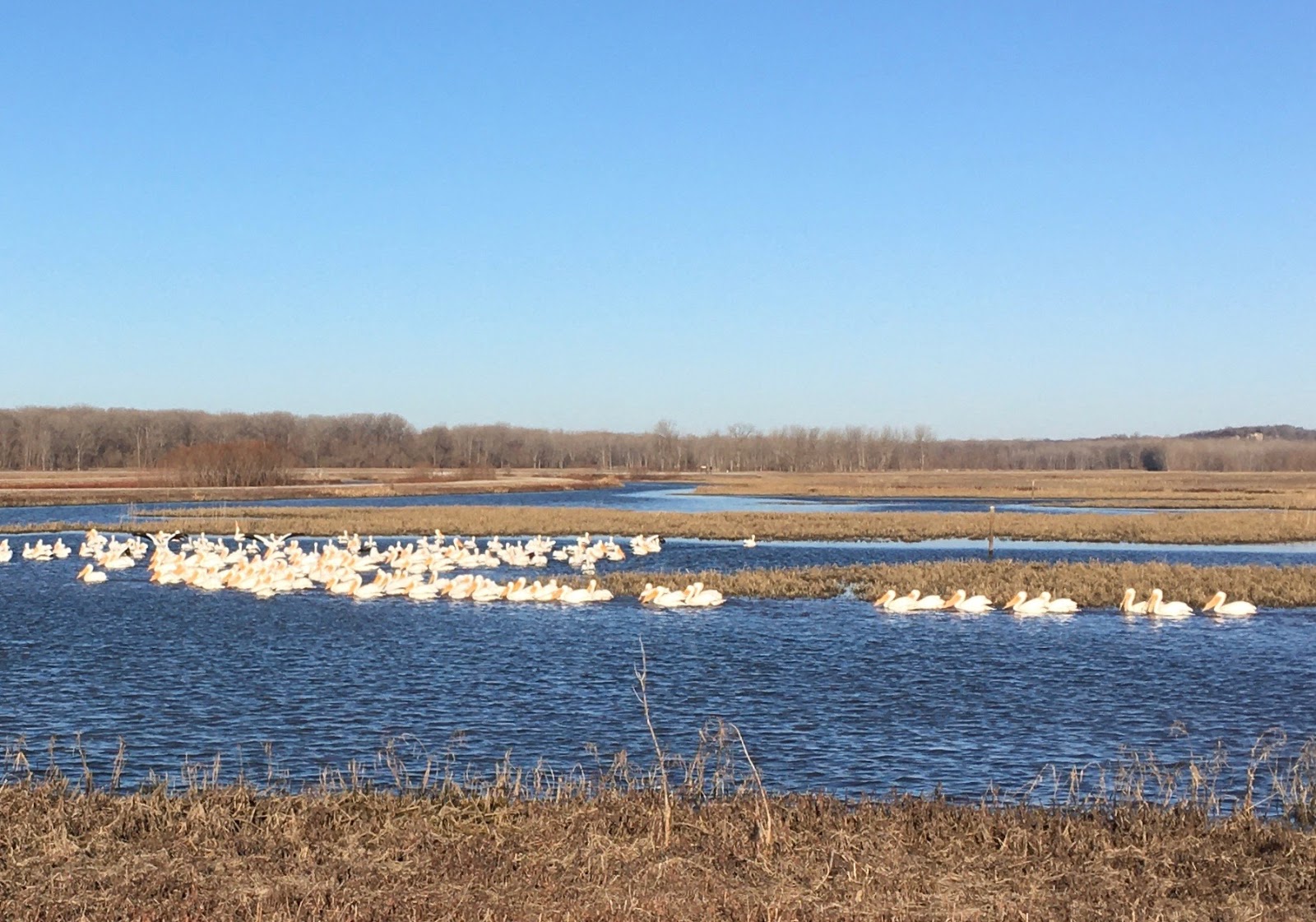
On this cool, rainy morning in central Missouri, a friend and I visited Eagle Bluffs Conservation Area, on the Missouri River floodplain; there, shallows covered most of the fields, attracting a large number and variety of ducks.  Northern shovelers dominated the scene, numbering at least 800 by my conservative count, joined by lesser but significant numbers of green-winged teal, American coot and blue-winged teal; the latter two species are just beginning to arrive in significant numbers (which usually peak in April).  Other sightings included at least 400 American white pelicans, a couple dozen great-blue herons, a large flock of lesser scaup, five bald eagles (two incubating eggs) and a squadron of tree swallows, the first of the season.

But this was a morning to enjoy the biannual influx of northern shovelers.  While some inhabit the refuge in winter and others dally into April, their spring migration through central Missouri generally peaks in mid-late March.  We were glad to witness that event.

Friday, March 13, 2020

A Chilly but Noisy Morning

On this cloudy, cool morning in Columbia, Missouri, I visited the Forum Nature Area in the Hinkson Creek Valley.  There, despite the chilly air, birdsong was intense, triggered by the lengthening daylight of early spring.

The songs of northern cardinals, American robins, tufted titmice, white-throated sparrows, red-winged blackbirds and song sparrows were most evident, mingled with the calls of Canada geese, red-tailed hawks, blue jays, red-bellied woodpeckers and northern flickers.  Less intense were the background chirps and tweets of chickadees, downy woodpeckers, eastern bluebirds and yellow-rumped warblers.  In some areas, the rising calls of chorus frogs drowned out the birdsong.

I had expected to encounter eastern phoebes and tree swallows on my walk through this floodplain refuge, the first summer songbirds to arrive each spring.  While they were not observed today, they will surely arrive within the next week or so, regardless of the weather that may greet them.

Thursday, March 12, 2020

Rumbling into Spring

Thunderstorms rumbled across central Missouri this morning and may re-develop this afternoon.  Since the clash zone between cool, dry air and warm humid air lies south of our region, the storms were not severe; in fact, the potential for strong thunderstorms with possible tornadoes currently stretches through Arkansas, southeast Missouri and the Ohio River Valley.

Looking at the weather map, one can see the effects of an undulating jet stream.  A deep, cold, atmospheric trough dips through the Intermountain West while "shallower" troughs dip across the Upper Midwest and New England.  South of the latter troughs, warm, humid air is streaming northward from the Gulf of Mexico, igniting bands of rain and thunderstorms where these atmospheric ridges and troughs collide.

This annual weather phenomenon usually begins along the Gulf Coast in February and the clash zone gradually drifts northward over the following months, fueled by heat from the rising sun angle.  Here in Missouri, potent spring thunderstorms generally peak from mid April into early May; today's thundershowers are but another sign that winter is retreating.

Wednesday, March 11, 2020

Spring Erupts at Phillips Lake

My wife and I frequently take walks around Perry Phillips Lake, in southeast Columbia; throughout this winter, the lake and its surrounding park were relatively devoid of birds (at least during our visits).


On this sunny, cool morning, all had changed.  Birdsong was intense and a pleasing mix of species moved through the lakeside shrubs, across the grasslands and into the nearby woodlands.  Dark-eyed juncos, white-throated sparrows and yellow-rumped warblers were most abundant, joined by lesser numbers of northern mockingbirds, mourning doves, eastern meadowlarks, robins, killdeer, song sparrows and an eastern phoebe.  American crows noisily moved through the Park which was patrolled by a lone red-tailed hawk and an American kestrel; a flock of Canada geese passed over the lake where buffleheads, lesser scaup, northern shovelers, gadwalls and pied-billed grebes had gathered.  Clouds of midges rose along the lakeshore and chorus frogs sang from shallow sloughs south of the lake.

While the spring equinox is still ten days away, the season has certainly taken hold here in central Missouri.  Wintry incursions may yet occur but the higher sun and unsettled jet stream will fuel a march toward the heart of spring. 

Monday, March 9, 2020

Politics, Fear & Coronavirus

As the coronavirus pandemic spreads across the globe, disrupting markets and the lives of citizens in most countries, the level of fear is rising.  While there is certainly justification for concern, politics has, once again, exacerbated the situation here in the United States.

President Trump's comments and behavior, fed by his extreme narcissism and paranoia, have repeatedly interfered with messaging from public health experts. Funding cutbacks at the CDC, his Administration's slow response to the coronavirus outbreak and his predilection to blame the media for hyping the crisis, have all inflamed distrust, fear and confusion across the country.  Having placed Pence and other sycophants in charge of our national response, Trump has doubled-down on efforts to protect himself from any high-level criticism.

As scary as the pandemic may be, it is the sense that our government is both ill-prepared and too politically-oriented to effectively deal with the pandemic that augments fear in America.  Self-indulgent leadership will only complicate the crisis.

Thursday, March 5, 2020

Killers in the Neighborhood

Over the past few days, eery cries have been ringing through our neighborhood in central Missouri, often beginning just after sunrise.  Their source is a pair of Cooper's hawks, swooping among the trees and perhaps beginning to nest in our neighbor's large walnut tree.

As occurs in most raptor species, the female is significantly larger than her mate but both are easily identified by their accipiter features, including a long, banded tail.  These hunters feed primarily on mid-sized birds (jays, doves, flickers) but will also take smaller prey.  Nevertheless, the songbirds in our yard appear to be relatively unfazed by their presence.

Permanent residents throughout most of the U.S., those that breed across Canada and the northern latitudes of our country generally migrate to warmer climes in winter.  Cooper's hawks once favored mature forest but have adapted well to human activity, now nesting and hunting in the open woodlands of river valleys, abandoned farmlands and suburbs.

Tuesday, March 3, 2020

Migration Surge at Eagle Bluffs

Back in Missouri for a month, I visited Eagle Bluffs Conservation Area on this sunny, cool morning.  Recent mild weather had scoured the landscape of ice and snow and the open pools hosted an excellent variety of migrants.

Most notable were at least 850 American white pelicans, gliding across the lakes or soaring above the floodplain.  Among the ducks, northern shovelers were most numerous; green-winged teal were also abundant, joining lesser numbers of mallards, northern pintails, lesser scaup, gadwall and a lone ruddy duck.  Canada geese were common while snow geese were limited to two flocks, totaling seventy birds.  Four bald eagles patrolled the refuge, two of which were already incubating their next generation.


The migration surge will build through March and into April, when blue-winged teal, coot and shorebirds join the northward exodus.  I hope to visit repeatedly during that period, honored to witness one of nature's most predictable yet stirring spectacles.

Saturday, February 29, 2020

Leap Day

Today is Leap Day, an event that occurs every four years (sort of).  Since the Earth completes its orbit around the sun in approximately 365 days, five hours and 49 minutes, adjustment had to be made to keep the Gregorian calendar in sync with the natural year.

In fact, by adding a day to February every 4 years, we would overshoot that adjustment; thus, leap day does not occur in years divisible by 100 unless they are are also divisible by 400 (e.g. 2100 will not be a leap year).

Such is our relationship with nature.  We do our best to adhere to her cycles and intricate mechanisms but often fail.  It is up to us to make adjustments, which are often neither accurate nor sufficient.  Mutations, which disrupt structure, behavior or sensitivities, offer a prime biological example, as the coronavirus is currently demonstrating.

Wednesday, February 26, 2020

Reassurance from the Chief Anti-Scientist

This evening, Our Dear Leader advised the American public that we have little to fear from the coronavirus pandemic (hyped by the fake news organizations) and named his adoring side-kick, Mike Pence, to oversee efforts to contain its spread in the U.S.  Pence is a perfect choice for the job since he will certainly never contradict the President.

Having cut funding for the CDC and World Health Organization, Trump is convinced that our medical experts will be able to control the virus (with the help of warm, spring weather, of course).  No doubt, he is primarily worried that the coronavirus will significantly impact our economy, just in time for the November elections.

However mild or severe its effects in the U.S. turn out to be, Trump will find someone to blame (Obama would seem to be a likely target).  Of course, we cannot expect any leadership from the Trump Administration, dominated as it is by anti-scientists and climate change deniers.

Tuesday, February 25, 2020

Past and Present

At any given point in our life, we are the product of our past, from the moment of conception until the immediate present.  We reflect our genetics and the experiences of our existence.

Who we are is determined by the love or abuse that we received, by the facts or lies that were instilled, by the opportunities that were extended or denied and by the nurturing or neglect that we experienced.  We are a product of encouragement or ridicule, of confidence or fear, of health or disability and of luck or misfortune.  The choices we made were determined by all of these intrinsic and extrinsic factors.

We cannot fully understand ourself or anyone else without knowing this information.  It underlies our capacity for self-discovery, empathy and tolerance and defines our common humanity.  

Sunday, February 23, 2020

Parental Traits

As teens and young adults, we recognize certain traits in our parents that were largely ignored during childhood.  In response, we vow to adopt those we admire and eschew those we despise but, in the end, are not always successful (a fact often pointed out by our spouse, our siblings or the other parent).

Indeed, we are a genetic composite of both parents and may not have the constitution to assume certain positive traits.  And when it comes to disavowing traits that we despise, we may overreact to the point of zealotry.

Genetic expression is a powerful force. Our goal, it seems to me, is to acknowledge the traits that we have inherited and work to modify their expression when indicated; education and social enlightenment are the primary tools that facilitate the process.

Saturday, February 22, 2020

Early Spring on the South Platte River

It may still be February, with snow covering the ground, but there were several signs of spring along the South Platte River this morning.  Sunshine was breaking through the high cloud layer and mild air had settled along the Front Range urban corridor.

Most conspicuous were the hysterical calls and drumming of northern flickers that inhabit groves of cottonwoods along the river.  In some areas, the distinctive "song" of red-winged blackbirds rose from the stream-side marshes, augmenting the background din.  Many of the wintering ducks were clearly agitated by seasonal hormones, including a group of male common goldeneyes that engaged in their classic courtship display, attempting to impress their female cohorts.  A pair of bald eagles, perhaps planning to nest in the area, cruised above the river, sending clouds of geese and ducks into the morning sky.


While we expect more snow tomorrow (and can count on other snowstorms throughout March, April and early May), spring has arrived in the South Platte Valley.  We humans may focus on calendars but our wild neighbors are more attuned to the ebb and flow of nature's seasons.  

Monday, February 17, 2020

Pelicans on Ice

On this cloudy, cool, drizzly morning, I headed down to Eagle Bluffs Conservation Area on the Missouri River floodplain.  There I was greeted by sloppy roads, soggy fields, icy shallows and chilly pools, a landscape not inviting to most humans but very attractive to migrant waterfowl.

Indeed, I encountered a wide variety of species, dominated by mallards and Canadian geese; other visitors included trumpeter swans, snow and greater white-fronted geese, lesser scaup, hooded mergansers, gadwalls, ring-necked ducks and American coot.  Five bald eagles and a pair of red-tailed hawks patrolled the refuge, where great blue herons stalked the shallows.


But this morning's highlight was provided by a flock of American white pelicans, huddled on a small island in the icy waters.  As I waited for them to take flight or move onto the pool, another flock arrived from the south, dropping down to join their cohorts.  They are all on their way to lakes of the Northern Plains (U.S. and Canada) where they will spend the warmer months and raise their young.  Having wintered along the Gulf Coast, they are among our earliest spring migrants; unlike human snowbirds, they are not inclined to wait for the balmy weather of April.

Saturday, February 15, 2020

The Great Backyard Bird Count

This weekend, February 14-17 (Friday-Monday), has been designated the 23rd Annual Great Backyard Bird Count by eBird.  Hoping to achieve the broadest assessment of bird populations across the globe, members are encouraged to file a report from their own backyard, thereby minimizing the duplication that often occurs at birding hotspots and expanding the coverage area.

Of course, I decided to participate and elected to limit my count to one hour.  On this cold, cloudy afternoon, only 13 species graced the property during that window, all of which are common winter residents in central Missouri.  Though I would like to have included a rare visitor or reported exceptionally high numbers, neither were in the cards; indeed, most of the species arrived within a single feeding group that spent less than 15 minutes in the yard.


Nevertheless, I was more than glad to join the global effort, however trivial my contribution.  The cumulative data will be vital to assessing the health of avian populations and documenting the impact of habitat loss and climate change.

Friday, February 14, 2020

True Love

Love, the most potent human emotion, is both hard to describe and difficult to understand; even so, the word itself, in my opinion, is greatly overused.  And, unlike the transient infatuations of youth, we come to realize that true love endures, mediated by our genes, our brain and our senses.

True love is indeed permanent.  It survives rejection, hardship, incompatibility and even abuse.  Despite what one hears in popular music, one does not "fall in and out" of love.

So, on this annual, commercialized celebration of love, we must acknowledge that true love is not dependent on jewelry, sweets or flowers.  Nevertheless, it is best not to ignore certain expectations!

See also: The Nature of Love

Tuesday, February 11, 2020

The Handsome Pintail

A circumpolar species, northern pintails breed across Alaska, Canada and the Northern Plains of the U.S., where they nest in open wetlands.  Come fall, they head to coastal and southern portions of the U.S. and Mexico, where they winter on both fresh and brackish waters; some pintails that breed in Siberia are known to winter in North America.

Feeding primarily on seeds, grain and aquatic vegetation in winter, these long-necked ducks also consume a host of aquatic invertebrates and small fish during the warmer months.  Male pintails are easily identified by their long, slender, white necks and distinctive head stripe, in addition to the long, pointed tail for which they are named (this pin-like tail is most prominent during the breeding season).

Among the earliest ducks to migrate northward in spring, these handsome ducks move in concert with the retreating ice and snow.  Indeed, I was fortunate to observe forty northern pintails at Eagle Bluffs Conservation Area this morning, just another sign that, almost two months past the winter solstice, spring is underway.  Then again, snow is forecast for tomorrow as another polar air mass invades the Heartland.

Saturday, February 8, 2020

Spring in the Air

It did not look or feel like spring at Eagle Bluffs Conservation Area this morning.  Snow covered the fields, ice coated most of the pools and the temperature stood at 28 degrees F.

A good diversity of waterfowl huddled on the ice or plied the open waters, including tundra swans, ring-necked ducks, gadwalls and a lone hooded merganser and common goldeneye (among more common species).  Raptors were represented by two bald eagles and a red-shouldered hawk and at least 200 ring-billed gulls graced the refuge.


Then, just before I left the floodplain preserve, a noisy flock of snow geese passed overhead, flying north through the Missouri River Valley.  Among the earliest signs of spring in the American Heartland, these hardy migrants are always a welcome sight in late winter as they begin their trek to the Arctic tundra. 

Wednesday, February 5, 2020

Down the Ohio Valley

Hoping to skirt the latest winter storm, which was pummeling Missouri and would soon move into northern Illinois, Indiana and Ohio, we decided to take a southern route to return to Columbia.  Driving SSE from Kent, Ohio, we entered the Muskingum River watershed within a few miles; this large network of streams and rivers drains most of the Appalachian Plateau in eastern Ohio, eventually entering the Ohio River.

Nearing Columbus, where highway signs warned of the approaching winter conditions, we entered the Scioto River watershed, another major tributary of the Ohio.  Then, in southwest Ohio, we crossed the Little Miami Valley before reaching the Ohio, itself, in downtown Cincinnati.  Once in Northern Kentucky, our route paralleled the Ohio River to the southwest as we undulated across the river hills, fording the Licking and Kentucky Rivers (southern tributaries of the Ohio) before reaching Louisville.

Cold rain developed halfway between Cincinnati and Louisville but it appears that we have safely avoided the snow and ice, at least for now.  We'll spend the night in Louisville before continuing through the Ohio Valley across southern Indiana and Illinois.  Eventually, we'll have to angle northwest to St. Louis and thence westward to Columbia but, hopefully, the roads will be clear by then.

Monday, February 3, 2020

Return to the Kent State Wetlands

On this mild, sunny day in Northeast Ohio, I decided to revisit the Kent State Wetlands in the southeast corner of the KSU Campus.  A mosaic of ponds, cattail marshes and mixed woodlands, the preserve is accessed by a hike-bike trail that leads to and from the University.


The major pond was still mostly ice-covered and waterfowl were limited to Canada geese and mallards.  A pair of red-shouldered hawks and a lone red-tailed hawk patrolled the refuge, where the usual mix of winter songbirds moved among the trees and shrubs.  Though sightings were limited, the pleasant weather and attractive ecosystem were rewarding enough.

Just a few miles from my wife's family cottage, the wetlands will surely be a regular destination in years to come.  Experienced birders and naturalists come to learn that favored areas for exploration are often close to home, partly due to convenience and partly due to their ecologic diversity. 

Saturday, February 1, 2020

Ohio's Grand River

Designated a Wild & Scenic River, Ohio's Grand River rises in the woodlands of southeast Geauga County and initially flows eastward across the Appalachian Plateau before turning north.  Most of its route courses through farmlands of western Ashtabula County before it carves a scenic gorge in Lake County and flows out to enter Lake Erie at Fairport Harbor.

Curving through the northeastern corner of the State, the Grand River is the most eastern of Ohio's major rivers to enter the Great Lakes/St. Lawrence watershed and thus the most eastern Ohio river north and east of the Eastern Continental Divide.  South of its watershed, the upper tributaries of the Mahoning River lie within the vast watershed of the Ohio River which, of course, empties into the Mississippi and thence into the Gulf of Mexico.

Yesterday, while visiting the North Coast, we encountered the lower Grand River at Painesville, at Headland Dunes, at the town of Grand River and at Fairport Harbor.  Someday, when the weather is more inviting, I hope to explore upper sections of this Wild & Scenic River.