Showing posts with label reptiles. Show all posts

Thursday, July 30, 2026

A Skink Emerges

As I discussed in A Skink Mystery, last September, our resident five-lined skinks, which were of usual abundance in the spring, disappeared throughout the summer.  In fact, they failed to emerge in the autumn as well and I came to the conclusion that a local die-off had occurred.

Very common on our Columbia property since we moved here in 1997, they would scurry across the deck and walkways or hang out at the compost bin to feast on a variety of invertebrates.  This spring and early summer passed without any sightings (though I am often out of town).  Then, about 10:30 this morning, as I lounged on our front porch, a young skink, sporting its bright blue tail, raced across the bricks.  He/she was the first I have seen here since the spring of 2025.

I have no explanation for this confusing saga but was glad to witness an apparent recovery.  Nature keeps us guessing. 

Saturday, September 13, 2025

A Skink Mystery

Common five-lined skinks, also known as blue-tailed skinks, have always been abundant around our Columbia, Missouri, house, most often seen scurrying across the deck or brick walkways.  While their numbers seemed to be normal this spring, I have not observed them at all this summer.

According. to the Missouri Department of Conservation, they tend to be most active from April into June but my past experience, over our 28 years in this neighborhood, has been that they are commonly observed during the summer and early autumn months as well.  A brief internet search failed to turn up any history of significant die-offs for this species.

Perhaps the hot, dry weather has kept them in sheltered areas, though we did receive quite a bit of rain back in July.  The mystery of their "disappearance" thus remains intact but I am hopeful that they may surface when early fall weather finally moves in.  If they don't "return" next spring, I will have to assume that some form of disease decimated the local population; that would be tragic for a skink watcher like myself (not to mention for the skinks). 

Thursday, April 17, 2025

Stranded Turtles at Eagle Bluffs

Returning to the dried out Conservation Area this morning, I found that almost all of the waders, waterfowl and shorebirds had fled Eagle Bluffs as the shallow pools continue to shrink.  Indeed, sighting highlights, what few there were, involved purely terrestrial species: deer, a northern harrier and a wild turkey, among others.

One sad observation were scattered "bales" of aquatic turtles, clustered along the stagnant pools or half buried in muddy channels, some a long way from any significant body of water.  While they might be able to tolerate periods of drought and are known for their ability to locate ponds or streams, they have just emerged from their winter hibernation and I doubt they have much physical reserve.

The human-imposed drought at Eagle Bluffs has certainly disappointed local birders and regional visitors but our personal welfare has not been threatened.  Seeing those turtles, stranded in the cracked mud, one easily understands the impact that our species has on less adaptable creatures.  Of course, this phenomenon is occurring across the globe as we destroy natural ecosystems and, in the process, threaten our own welfare. 

Tuesday, March 25, 2025

The Skinks Resurface

Yesterday, I heard rustling in the leaves along our Columbia house and suspected that a five-lined skink had resurfaced from its winter burrow following our recent, mild weather.  That suspicion was confirmed this afternoon as a large, male skink scurried across the deck.

While another cold spell may send them back to their burrows, it is time to bulk up on larvae, insects, spiders and fruit if encountered.  As I have reported in the past,  these reptiles frequently visit our compost bin to gnaw on our kitchen waste and to feast on invertebrates drawn to the handouts.

Mating will generally take place in May and the young, with their bright-blue tails, seem to be everywhere by mid summer.  Though harmless, these active creatures tend to spook children (and some adults) since they are a bit snake-like in appearance.  The rest of us just enjoy watching their antics, squeezing through the narrowest crevices in search of prey.  

Sunday, June 23, 2024

Bird vs. Snake

On this beautiful and less humid morning, I made another summer visit to Eagle Bluffs Conservation Area.  Though it is still too early for the shorebird migration to begin, I did encounter a decent variety of birds, including a family of wood ducks and a lone Mississippi kite.  But the highlight of my visit was provided by a single bird.

Experienced birders know that red-winged blackbirds are bold and aggressive creatures, inclined to defend their territory from any perceived enemy.  This morning, one demonstrated a rather extreme example of that trait, chasing a large black snake across the road.  Nipping at its tail as the reptile headed for cover in the marsh, the red-wing was fearless in his attack.

Of course, instinct and intelligence are two different things and a sudden swipe of the snake's tail might have put an end to the hero's life.  As it turned out, he was able to return to his flock where the reception was likely just as instinctual (i.e. no medals or parades). 

Saturday, July 8, 2023

A Reptile Imbalance?

When we purchased our modest-sized, suburban property in Columbia, Missouri, 26 years ago, garter snakes were regularly observed in the yard and flower beds; during some springs, their young seemed to be everywhere.  We also noticed a fair number of five-lined skinks (also known as blue-tailed skinks) on the property.

Now, two decades later, the skinks are abundant and the snakes are all but absent.  I suspect the garter snakes had preyed on the skinks, keeping their population in check; once their numbers crashed (for reasons unknown....perhaps predation by opossums, raccoons and red-shouldered hawks), the skink population exploded.

Though I am unsure regarding the specifics, it appears that our reptilian imbalance is symbolic of the predator-prey relationships that we observe in all natural ecosystems.  As with the gyrations of the cottontail population on our Littleton, Colorado, farm, in relation to the presence or absence of red fox, population dynamics are most evident in contained environments.  Since we humans seem committed to carving up what little open space remains, such imbalances will likely lead to an accelerated rate of extinction. 

Tuesday, June 13, 2023

Western Rat Snake

On my birding excursion late this morning, the birds were not especially abundant or conspicuous.  However, I did encounter one of the largest black snakes that I have ever seen, stretched across a gravel road.

Officially, it was a western rat snake, found throughout the central portion of the U.S.; while guidebooks indicate that they may reach six feet in length, this one appeared to be a bit larger.  Sunning itself on the roadway, it moved off into tall grass as my vehicle slowly approached.

Since this is still their breeding season, the snake may have been searching for a mate; up to twenty eggs, which hatch in late summer, are laid by the female.  Western rat snakes are constrictors and feed on a variety of small mammals, amphibians and lizards; since they are excellent climbers, they also hunt for avian nestlings and eggs.  They, themselves, may be victims of hawks (especially red-shouldered hawks), fox, mink, coyotes and, of course, automobiles and tractors.  Those that survive the summer den in caves or deep rock crevices, often in the company of copperheads and rattlesnakes.   

Friday, February 10, 2023

Sam D. Hamilton Noxubee NWR

Named for a local and national conservationist, the Sam D. Hamilton Noxubee National Wildlife Refuge stretches across the Noxubee River Valley in east-central Mississippi.  Its informative Visitor Center, fine trail network and multiple boardwalks make it seem more like a State Park than a NWR.

The damming of Oktoc and Loakfoma Creeks has created two sizable lakes, bordered by forest and baldcypress swamps.  A restored prairie augments the natural diversity and offers a spectacular view of the lakes.  Bald eagles, ospreys, migrant waterfowl, cormorants, barred owls, red-cockaded woodpeckers and a wide variety of waders highlight the avian population; alligators, river otters, bobcats, fox, beaver, white-tailed deer and a host of snakes and turtles may also be encountered.

Mild weather and bright sunshine made our visit especially enjoyable.  It was also rewarding to learn that this large, attractive refuge honors a man who dedicated his life to protecting natural ecosystems. 

Wednesday, June 8, 2022

A Skink in the Compost Bin

When taking watermelon rinds out to the compost bin last evening, I opened the lid to find a five-lined skink (also known as a blue-tailed skink) scurrying across the vegetative debris.  A dedicated insectivore, he was surely taking advantage of the fact that numerous insects and spiders are drawn to the bin's rotting contents.

In a way, we are facilitating his hunting activity, just as bird feeding concentrates prey for a number of falcons, hawks and other predators.  Are we thereby creating an imbalance in our backyard ecosystem or does the value of a compost bin outweigh the impact on our resident invertebrates?  Should I screen in the compost to keep out predators?

This argument is partly in jest but also reminds us that most human activity, however well-intentioned, has an impact on natural ecosystems.  Our species broke from those ecosystems once we developed the means to avoid being prey ourselves.  For now, with all due respect to the spiders and insects, I will not evict the skink from our compost bin.

Friday, July 9, 2021

A Newborn Skink

American five-lined skinks are common on our Columbia, Missouri, property and I have surely seen hundreds of them over the past two decades.  But, for the first time, I observed a tiny hatchling while sitting on the porch last evening.

No larger than an earthworm, the newborn skink, sporting the bright blue tail of a juvenile, foraged within the crevices of our brick walkway.  Its mother was impregnated back in May, laid her eggs (up to 18) in June and cared for them until they hatched (after an incubation of 4-6 weeks).  The youngster that I encountered was surely no more than a few days old but may live for up to six years.

Five-lined skinks feast on a wide variety of spiders and insects in addition to fruit and vegetable matter.  They, themselves, are potential prey for crows, jays, herons and a host of small mammals.  My best wishes for our newborn neighbor. 

Monday, July 5, 2021

Warrior in the Grass

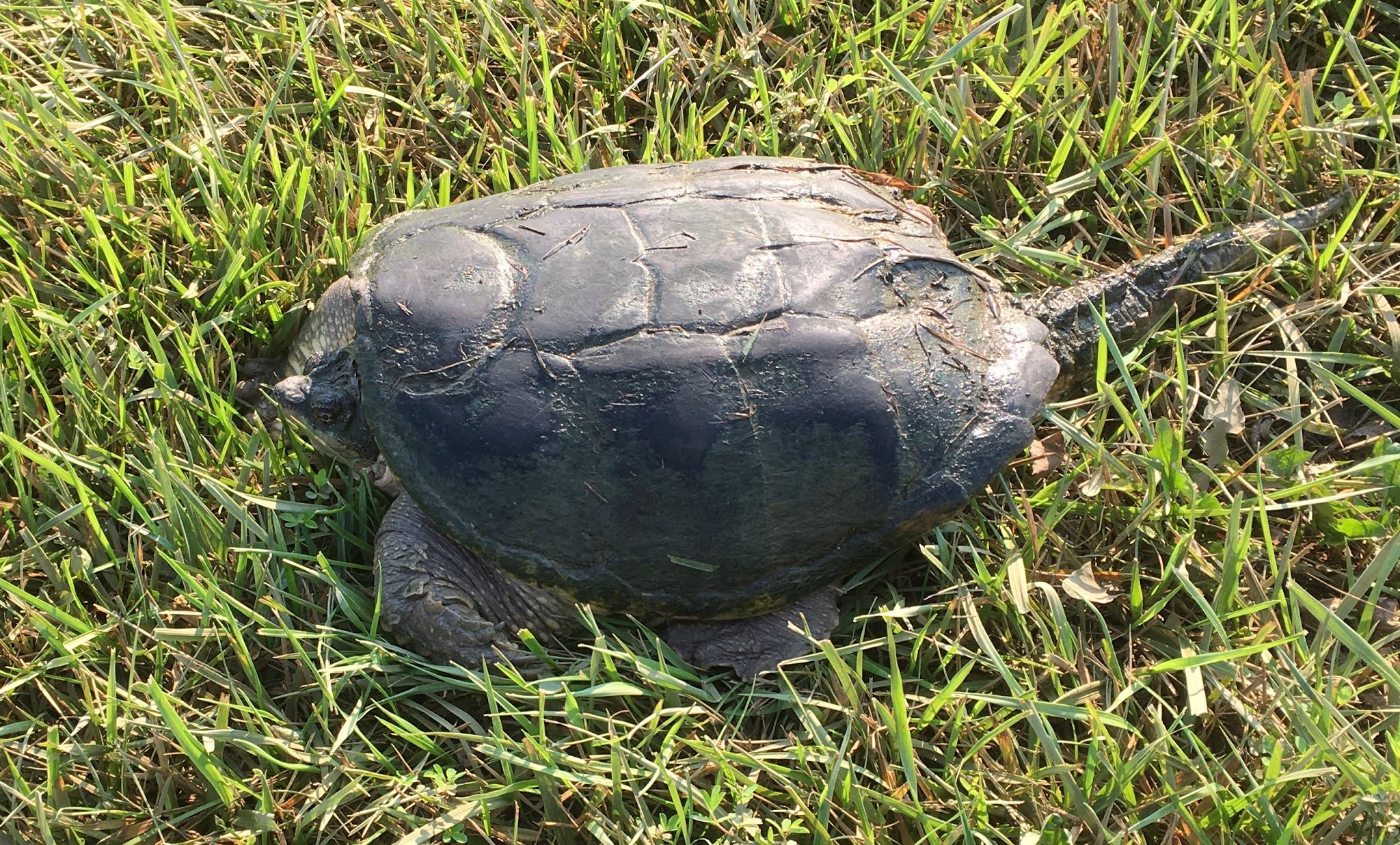
Walking around Phillips Lake this morning, in southeast Columbia, my wife and I encountered a snapping turtle, lounging in the grass.  Since these long-lived, prehistoric creatures seldom leave their aquatic home, I surmised it was likely a female, surveying a location to lay her eggs.

Found throughout the eastern 2/3 of North America, common snapping turtles have a low level of successful reproduction but may live for a century.  Favoring shallow lakes and bays, they feed on a wide variety of creatures, including invertebrates, fish, frogs and aquatic turtles, unwary herons and small mammals as well as on carrion.  Natural predators are limited to larger snappers, alligators, river otters (when the snappers are relatively young) and coyotes or bears (when traveling to nest sites or between lakes).

Indeed, the snapper that we observed this morning was missing a section of its posterior carapace and several leeches were attached to the exposed skin.  The natural world is almost always beautiful from a distance but close inspection often reveals the scars of life in the wild.

Thursday, May 27, 2021

Gators of the Alachua Sink

On the southeast edge of Gainesville, Florida, at the south end of 15th St. SE, the La Chua trail leads into the Alachua Sink within the Paynesville Prairie Basin (see the earlier post this month).  From the parking lot, a paved trail soon becomes a fine boardwalk, which zigzags above vegetated shallows of the Sink.


We arrived by mid morning, hoping to observe a few alligators during our brief visit; as it turned out, we saw at least twenty, basking on the banks or gliding across the open pools.  Attentive to those fickle reptiles, a host of herons and egrets lined the shores, attempting to snare fish without becoming victims themselves.  To our delight, a pair of limpkins also graced the scene.

In the interest of time and due to the building heat, we did not continue along the trail which becomes an earthen path that leads out to drier areas of the prairie.  Also intolerant of the rising temperature, the alligators slipped into the shallows as we retraced our route to the parking lot.

Saturday, May 15, 2021

Stopping by Paynes Prairie

Paynes Prairie State Nature Preserve covers a massive sinkhole basin just south of Gainesville, Florida.  While we have crossed the refuge many times on Interstate 75, we have never visited, until yesterday.  After taking Exit 374 at Micanopy, we followed signs to the south entrance, paid an entry fee and drove back to the Visitor Center which commands a spectacular view of the basin.

From the Center, a short trail leads out to an overlook tower.  Once atop the structure, we observed great and cattle egrets feeding in the basin, joined by a small flock of sandhill cranes and a lone whooping crane that has settled in at the preserve.  We saw a couple of the wild horses that roam the prairie but could not locate the resident bison herd.  Pressed for time, we did not explore the trail network that leads through woodlands atop the basin and along the edge of its floor.

Shallow lakes across the basin represent sinks where the underlying aquifer surfaces within the scrub prairie.  American alligators are abundant in these wetlands and we were told they are especially conspicuous along the rail bed trail on the north edge of the refuge (on the south side of Gainesville).  We plan to check for ourselves when we head back north. 

Thursday, April 22, 2021

Earth Day at Garth Nature Area

Garth Nature Area is a landscape of ponds, wetlands, floodplain woodlands and hillside forest in north Columbia, Missouri.  As one might expect, it is an excellent destination for naturalists and an appropriate location to celebrate Earth Day.

On this cool, sunny morning, my wife and I walked along its network of graveled trails, noticing the handiwork of beavers along the way.  We first encountered two pair of Canada geese herding their fuzzy goslings and soon observed a prothonotary warbler, the first warbler I have seen this spring; other sightings included turkey vultures, blue-winged teal, a red-tailed hawk, painted turtles and the usual mix of resident songbirds.  But the highlight of our visit was a remarkable number of ruby-crowned kinglets, spaced along the main loop trail.  These tiny, active songbirds are fairly common in the Midwest during April, traveling from wintering sites in the Southern States and Mexico to their Canadian breeding grounds; usually observed alone or in pairs, their congregation was an unexpected treat. 

On this annual commitment to conservation, it is best to meet nature on her terms.  Festivals, speeches and political declarations have their benefits but they cannot replace immersing oneself in a natural ecosystem, where we witness the diversity, fragility and interdependence of life on our planet. 

Monday, October 5, 2020

Paint Mines Interpretive Park

About 35 miles east of Colorado Springs and two miles south of Calhan, Colorado, a creek and its side streams have sculpted a badlands from the north flank of a high ridge.  Now protected within Paint Mines Interpretive Park, the badlands are a colorful mosaic of bluffs, domes and hoodoos, representing Tertiary and Quaternary deposits.  The Park's name is a reference to the fact the Native Americans used the clays for decorative purposes.


Accessed by a network of sand-gravel trails that overlook and wind among the rock formations, the park is home to an excellent variety of plants and animals that characterize the Western High Plains; among the resident wildlife are coyotes, red fox, white-tailed deer, ferruginous hawks, prairie falcons, thirteen-lined ground squirrels and short-horned lizards.  Unfortunately, perhaps due to the number of visitors, we only encountered the ground squirrels this morning.

A wind farm now stretches atop the ridge above the park but the ecology of this hidden, geologic gem appears to be undisturbed.  The stream itself is an upper tributary of Big Sandy Creek which drains part of the Arkansas River watershed, south of the Palmer Divide.  Finally, from atop the ridge, one (I imagine) enjoys a spectacular view of the Pike's Peak massif and the distant Continental Divide; unfortunately, a smoky haze from the Western wildfires obliterated that view today.    

Sunday, April 19, 2020

Spring Breaks Through

After a very sluggish start, it appears that spring has finally displaced winter in central Missouri.  The hardy magnolias have lost their blossoms and redbuds and lilacs now adorn the landscape.  Most of the summer songbirds have returned and spring migrants are passing through.  And, perhaps most inviting, we are looking forward to a warm week, with highs in the 60s and 70s F and lows well above the risk for snow or ice.

Of course, here in the Midwest, showers and thunderstorms can be expected but warm precipitation is certainly preferable to the cold rain and wintry mix of March and early April.  Toads are trilling, snakes, lizards and turtles have emerged from their winter retreats and young cottontails are dining on wildflowers that now grace the lawn.

During this difficult spring, when most of us are confined to our homes, the warm weather and increasing natural diversity are especially welcome.  One could spend a lifetime learning about the many creatures and plants in their own backyard and this is a perfect year to expand that knowledge. 

Thursday, April 2, 2020

Skink Season

Following a period of warm weather, five-lined skinks are once again active on our Columbia, Missouri, property.  These common reptiles are also known as blue-tailed skinks since juveniles sport bright blue tails; adult males, on the other hand, have an orange-colored head during breeding season.

Favoring sunny areas, these skinks bask on rock walls, decks and wooden fences between sorties to feast on a wide variety of invertebrates (insects, spiders, slugs, earthworms).  Nesting begins by late April and the nest is placed on the ground in a sheltered location; the female tends to the eggs until they hatch, eating those that fail to do so.  As with other reptiles, the young are on their own once they emerge and the blue tails in this species may ward off predators (including adult male skinks).

Five-lined skinks will remain active into October, scurrying across the deck or rustling through the leaf litter to locate prey.  Predators include fox, raccoons, opossums, snakes, hawks, crows and house cats.  Come fall, they seek refuge in wood piles, hollow logs, abandoned dens and foundation cracks, among other sheltered sites.

Friday, November 8, 2019

Lake Manatee State Park

Lake Manatee, a reservoir on the Manatee River east of Bradenton, was created in the 1960s; Lake Manatee State Park stretches along its southern shore.  Those who visit the Park to camp or hike while enjoying views of the Lake may be a bit disappointed; indeed, shoreline views of Lake Manatee are limited to the boat launch and the small swimming area.

The Park's trails primarily loop through scrubby flat woods, characterized by stands of pine, live oak and palmetto, offering only distant views of the lake.  On the other hand, hikers may encounter gopher tortoises, indigo snakes, marsh rabbits and gray fox; plants of interest include garberia and the rare Florida goldenaster.  Birds of note include bald eagles, ospreys and sandhill cranes and American alligators may be observed.

On this hot, sunny morning, we followed the 1.8 mile Gopher Trail Loop in the eastern section of the Park.  Sightings included a lone anhinga, an osprey, black vultures, Cooper's hawks, red-bellied woodpeckers and gray catbirds, among other songbirds.  An early morning or evening hike would have been more enjoyable and more productive for wildlife viewing.

Saturday, June 22, 2019

Insect Control on the Farm

As I have mentioned in the past, we do not use insecticides on our Littleton, Colorado, farm.  However, we do host hundreds of assistants that keep the insect population in check, working for nothing more than their meals.

Chickadees, nuthatches, bushtits, woodpeckers, warblers, gnatcatchers, catbirds, house wrens, western tanagers and Bullock's orioles glean insects from the trees and shrubs.  Flycatchers, Say's phoebes, cedar waxwings, tree and barn swallows, broad-tailed hummingbirds and western kingbirds snare them from mid air, joined by little brown bats and common nighthawks at dusk.  American robins, crows, starlings, grackles, flickers, blue jays, magpies, kestrels and spotted towhees scour the ground for insects and grubs, assisted by garter snakes, lizards and the occasional toad.  Even a few insects (primarily dragonflies, ladybird beetles and wasps) take part, not to mention most spiders.

In return for their work, we offer a wide diversity of native foliage (including berry crops), brush piles, a source of fresh water and an insecticide-free landscape.  Quite a deal for us and a choice that all property owners can easily make in our joint effort to protect the environment.

Tuesday, April 16, 2019

Browns Park National Wildlife Refuge

Browns Park is a broad river valley in extreme northwest Colorado, bordered by the Diamond Mountains (the eastern end of the Uinta Range) to the west and the Cold Springs Mountain ridge to the east.  The Green River, a major tributary of the Colorado, courses through the valley after leaving Flaming Gorge in Utah; in southern Browns Park, it re-enters the mountains at the spectacular Gates of Lodore (within Dinosaur National Monument).

Browns Park National Wildlife Refuge was established in 1965 to protect vital riverine wetlands and associated riparian habitats which have long been nourished by seasonal flooding.  Following the construction of the Flaming Gorge Dam (which eliminated that flooding) refuge personnel established a water management system that pumps water from the river and local creeks into the wetland areas.  After all, migrant birds have long relied on these wetlands as they cross the dry terrain of western Colorado; in addition, many species of waterfowl and shorebirds nest along the Green River.

The 12,150 acre refuge protects those riverine habitats as well as a swath of upland shrub zone, characterized by sage, greasewood, needle grass, piñon pine and Utah juniper.  Among the 68 species of mammal that inhabit the refuge are moose, mule deer, pronghorns, river otters, badgers, beaver and wintering herds of elk.  Other species of note include golden and bald eagles, sage grouse, white-faced ibis, American bitterns, Woodhouse's toads and, of course, rattlesnakes.  The spectacular scenery and solitude of this remote refuge are equally appealing to the visitor; during my two-hour visit (admittedly on a Monday afternoon), I did not encounter another human being.